
contact info
- 3rd Floor, Gujranwala Business Center, Near KFC, G.T. Road, Gujranwala, Pakistan
- +92 303 0813333
- +92 303 0644484
- info@hashlearning.com
- info@hashlearning.com
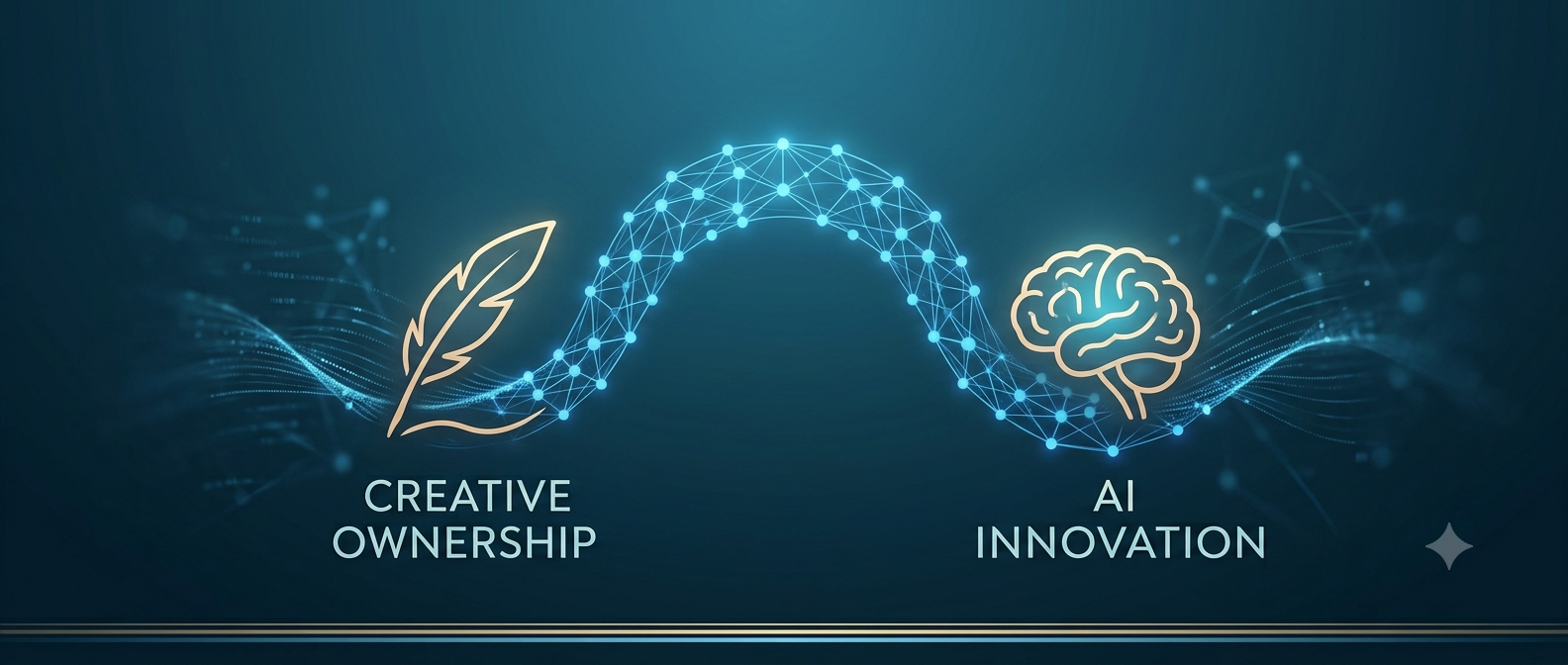
The intersection of generative artificial intelligence and intellectual property law reached a defining legal threshold following landmark summary judgments in U.S. federal district courts. Judges ruled that utilizing copyrighted literature—even works pulled from unauthorized databases—to train Large Language Models (LLMs) constitutes protected “fair use” under Section 107 of the U.S. Copyright Act.
This AI copyright ruling establishes a massive legal precedent for tech developers like OpenAI, Meta, Google, and Anthropic. However, it has simultaneously ignited intense debate among writers, copyright lawyers, and creative unions who argue that machine learning ingestion threatens the fundamental economic structure of creative ownership.
Legal Precedent for Model Ingestion: District courts ruled that processing full text files to extract statistical language patterns is “quintessentially transformative” and protected under fair use.
Crucial Legal Distinction (Training vs. Piracy Storage): While extracting linguistic patterns during model training qualifies as transformative fair use, courts drew a hard line against downloading and retaining permanent pirated digital libraries purely for general storage.
Shift in Evidentiary Standards: Federal judges noted that the failure of author groups to demonstrate direct market substitution or empirical financial harm heavily swayed factor four of the fair use analysis in favor of tech developers.
Emergence of Global Jurisdictional Friction: The permissive U.S. judicial stance creates a sharp divide against regions like the European Union, where the EU AI Act enforces mandatory opt-out mechanisms for text and data mining.
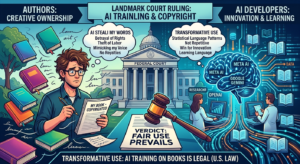
The generative AI boom required machine learning models to ingest hundreds of billions of text parameters to achieve human-like linguistic fluency. AI developers sourced datasets across the internet, drawing from academic journals, news repositories, public forums, and digital literature collections.
Central to the lawsuits was Books3, an unauthorized dataset containing approximately 190,000 digitized titles extracted from shadow libraries such as Bibliotik. High-profile authors—including Sarah Silverman, Paul Tremblay, Douglas Preston, Mona Awad, and Richard Kadrey—consolidated class-action lawsuits against Meta and OpenAI. They asserted that:
Expressive creative works were ingested into training pipelines without explicit authorization, credit, or financial royalties.
Synthetic outputs produced by advanced language models could reproduce distinct authorial styles, diluting the market for original literature.
The underlying commercial products derived from these datasets generated billions of dollars in enterprise value using uncompensated human creative labor.
In evaluating whether training AI models on copyrighted books violates 17 U.S.C. § 107, federal judges systematically examined the four traditional factors of fair use.
| Fair Use Factor | Court Determination | Detailed Judicial & Legal Rationale |
| 1. Purpose & Character of Use | Highly Transformative (Favors AI) | The primary objective is to teach an algorithm statistical rules, grammar, and semantic relationships rather than republishing or reselling the expressive storytelling. |
| 2. Nature of Copyrighted Work | Neutral / Favors Authors | Books are highly expressive and creative original works, which typically receive strong copyright protection. However, the transformative purpose reduces the weight of this factor. |
| 3. Amount & Substantiality Used | Acceptable (Favors AI) | While 100% of the book text was processed, ingesting the full text was technically necessary for complete language modeling and did not remain stored as readable text inside the model. |
| 4. Effect on Potential Market | No Direct Market Harm (Favors AI) | Plaintiffs failed to present concrete economic data proving that training an LLM directly cannibalized book sales or substituted the market for original reading material. |
Judicial Opinion Highlights
Federal judges noted in their summary judgments that using literary works to build statistical language models serves a different purpose than the original prose.
“The purpose and character of using copyrighted works to train LLMs was transformative—spectacularly so… Like any reader aspiring to be a writer, AI models train upon works not to replicate them, but to create something entirely different.”
While this AI copyright ruling establishes protection for algorithmic training, courts established a clear legal distinction regarding how datasets are sourced and stored long-term.
In cases like Bartz v. Anthropic and Kadrey v. Meta, judges separated model training from raw file acquisition:
The Ingestion Process: Ingesting text files into a neural network to calculate mathematical parameter weights qualifies as transformative fair use.
Permanent Pirated Repositories: Downloading millions of unauthorized e-books from shadow libraries to construct permanent, central digital archives inside a corporate infrastructure without paying licensing fees constitutes actionable copyright infringementAI copyright ruling.
This distinction means AI companies remain exposed to substantial copyright liability and financial damages for unlawful file procurement and unauthorized data storage, even if the model training step itself is protected AI copyright ruling.
Writer organizations, literary agents, and individual creators express grave concern that this legal stance enables corporate exploitation of human intellectual property.
“If a company can absorb my book into its system, train its AI to mimic my voice, and then generate content that competes with me—without asking or paying—that’s not innovation, it’s theft.”
— Douglas Preston, Author & Guild Representative
Authors contend that:
Market dilution occurs indirectly when generative tools flood retail platforms with synthetic content written in recognizable authorial styles.
The loss of licensing revenue deprives creators of fundamental economic compensation for their foundational contributions to AI developmentAI copyright ruling.
2. AI Developers, Open-Source Communities & Legal Counsel
AI researchers and corporate legal teams maintain that mandatory blanket licensing for all training data would stall technological progress and consolidate market power exclusively among ultra-wealthy tech conglomerates.
“This ruling validates a practical approach to building intelligent systems. It’s not about copying books—it’s about learning human language.”
— Jennifer Stiles, AI Researcher
Developers argue that:
Language models do not act as digital archives; they do not store exact text files inside their deployment code.
Requiring individual licenses for billions of data points would create insurmountable transactional friction for academic researchers and open-source startups.AI copyright ruling
Because U.S. district court decisions apply strictly within U.S. jurisdiction, AI firms operating internationally face varying regulatory regimes across global marketsAI copyright ruling.
United States: Precedent favors transformative use for model ingestion, shifting legal focus toward evidentiary proof of direct market substitution.
European Union: Under the EU AI Act, AI models must respect copyright law and allow authors to opt out of text-and-data-mining (TDM).
Canada, Australia, & India: Legal frameworks are still evolving, but they tend to lean more toward protecting copyright holders.AI copyright ruling
The legal battle over AI training data is far from resolved. Anticipated next developments after this initial AI copyright ruling include:
Appeals to Circuit Courts: Plaintiff author groups have initiated appellate proceedings, pushing the issue toward appellate courts and setting up a potential future review by the U.S. Supreme Court.
Expansion of Voluntary Licensing Marketplaces: Despite favorable fair use rulings, major tech firms continue entering multi-million dollar licensing agreements with major publishers and digital media platforms to guarantee access to clean, non-pirated data streams AI copyright ruling.
Targeted Legislative Proposals: Calls are growing for congressional action to update outdated copyright laws for the AI age.
Can an AI model recreate a copyrighted book word-for-word?
No. LLMs operate probabilistically by predicting the most statistically likely word sequences rather than retrieving stored text. However, if a prompt forces an output that duplicates long sections verbatim, that specific output can still trigger direct copyright infringement claims.AI copyright ruling
Does this ruling mean downloading pirated books is legal for AI companies?
No. Courts explicitly noted that downloading, duplicating, and permanently retaining pirated files from unauthorized shadow libraries remains a violation of copyright law, separate from the transformative training processAI copyright ruling.
How can authors protect their future works from AI data scrapers?
Authors can utilize technical protocols such as robots.txt AI scraper blocks, publish under licensing terms that explicitly exclude text-and-data mining, and leverage regulatory protections available in regions like the EU that enforce opt-out rights.AI copyright ruling
This AI copyright ruling represents a critical legal milestone in modern intellectual property law. By categorizing machine learning training as transformative fair use while holding companies accountable for unlawful file piracy, courts are establishing a delicate middle ground between technological innovation and creator protection. As appellate courts and global regulators weigh in, the legal parameters governing synthetic intelligence and human creativity will continue to adapt.
You must be logged in to post a comment.
