

contact info
- 3rd Floor, Gujranwala Business Center, Near KFC, G.T. Road, Gujranwala, Pakistan
- +92 303 0813333
- +92 303 0644484
- info@hashlearning.com
- info@hashlearning.com
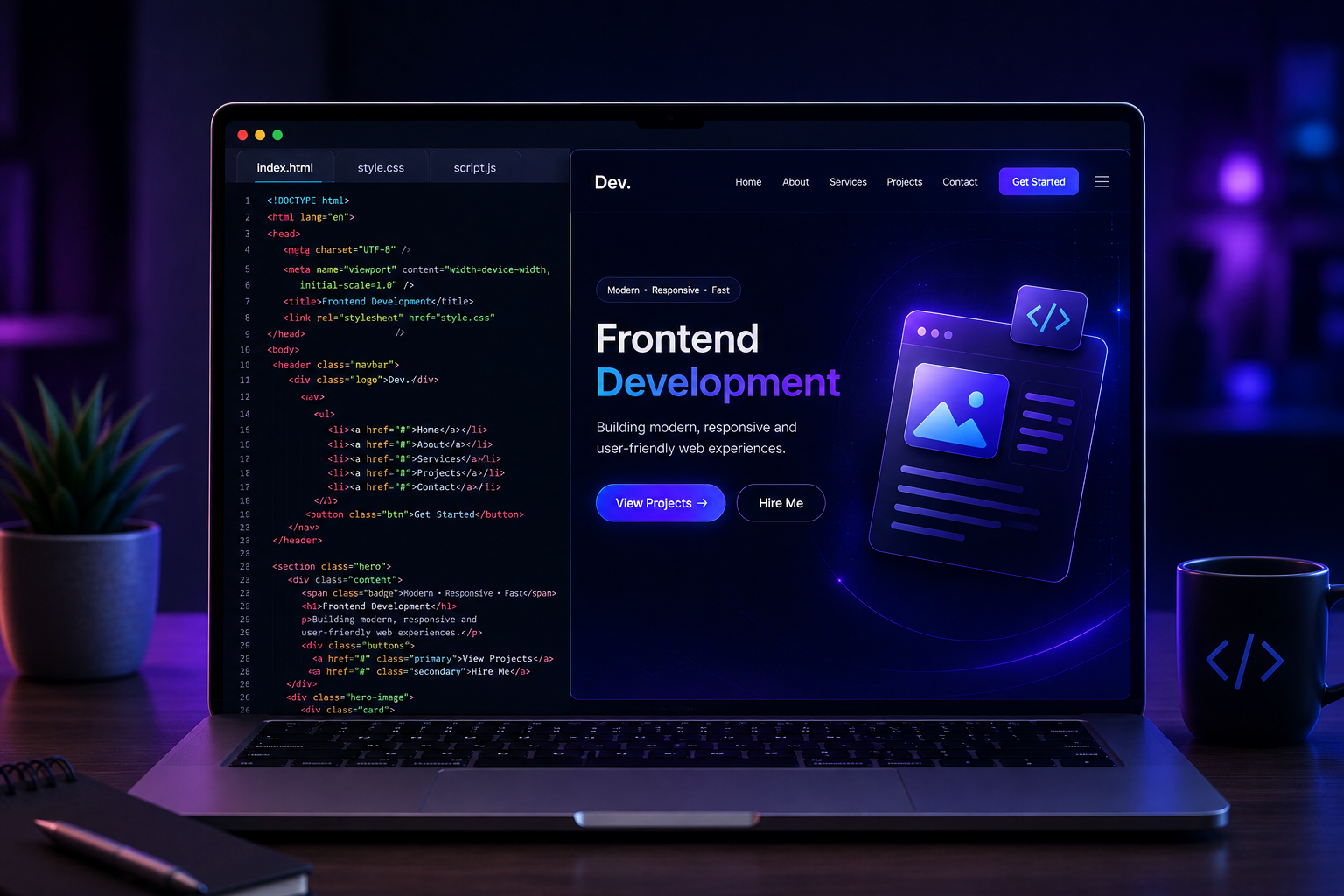
The demand for professional websites and web applications continues to grow in 2026, making frontend development one of the most valuable skills for students, beginners, freelancers, and aspiring developers. Every modern website needs a user-friendly interface, responsive design, attractive layouts, and smooth interactions. This is where frontend developers play an important role.
If you are planning to start a career in web development, taking a structured frontend development course can help you learn the right skills in the correct order. Instead of jumping between random tutorials, a proper course can give you practical knowledge, projects, and a clear learning path.
In this guide, you will learn what frontend development is, which technologies you should learn, why a website designing course can help, and how you can prepare yourself for a professional career in web development.
Frontend development is the process of creating the part of a website or web application that users see and interact with directly. It includes everything from navigation menus and buttons to images, forms, animations, layouts, and responsive designs.
A frontend developer converts a website design into a functional webpage using technologies such as HTML, CSS, and JavaScript. They also make sure that websites work properly on desktops, tablets, and mobile devices.
Frontend development combines creativity, design, and programming, making it an excellent career choice for people who enjoy both visual design and technology.
Learning frontend development can open the door to several opportunities in the technology industry. Businesses of every size need websites, landing pages, e-commerce stores, and web applications.
Some important benefits include:
For beginners, frontend development is also a practical way to enter the technology industry because you can start creating useful projects after learning the basic technologies.
A good frontend development course should cover the fundamental skills before introducing advanced frameworks.
HTML, or HyperText Markup Language, provides the structure of a webpage. It is used to create headings, paragraphs, images, links, forms, tables, and other webpage elements.
Learning semantic HTML is especially important because it helps create websites that are easier for search engines, browsers, and users to understand.
CSS controls the visual appearance of a website. Developers use CSS to manage colors, fonts, spacing, layouts, borders, animations, and responsive designs.
A strong understanding of CSS allows developers to transform a basic HTML page into a professional-looking website.
JavaScript adds functionality and interactivity to websites. It can be used for form validation, dropdown menus, sliders, pop-ups, dynamic content, and interactive web applications.
Once you understand HTML and CSS, learning JavaScript is an important next step toward becoming a professional frontend developer.
A website must work properly on different screen sizes. Responsive web design ensures that content automatically adjusts according to the device being used.
You should learn techniques such as:
Responsive design is an essential part of modern website designing.
After developing a strong understanding of HTML, CSS, and JavaScript, you can move toward frontend frameworks and libraries.
Popular technologies include:
React is particularly popular for building modern interactive web applications. However, beginners should avoid learning a framework before understanding the fundamentals.
A structured frontend development course can help you follow this progression without becoming overwhelmed.
Many beginners try to learn web development through random videos and articles. While free resources can be helpful, they can sometimes make the learning process confusing because topics are not always presented in a logical order.
A structured Website Designing Course can provide a clear learning path from fundamentals to practical projects.
For example, Hash Learning’s Website Designing course is designed to help learners understand important website development concepts while developing practical skills.
A guided learning experience can be especially useful for beginners who want to understand concepts step by step and build projects instead of only watching tutorials.
One of the biggest mistakes beginners make is focusing only on theory. Watching dozens of tutorials does not automatically make someone a good developer.
The best way to improve your frontend development skills is to build projects.
Start with simple projects such as:
Projects help you understand how different technologies work together and give you something valuable to showcase in your portfolio.

Professional frontend developers use several tools during their workflow.
Visual Studio Code is a popular code editor used for writing and managing frontend code.
Figma is commonly used for UI/UX design. Developers can use Figma designs as a reference when converting visual concepts into working websites.
Chrome DevTools helps developers inspect HTML and CSS, debug JavaScript, test responsive layouts, and identify performance problems.
Git is used for version control, while GitHub provides a platform for storing and collaborating on code projects.
Learning these tools alongside frontend technologies can make you more prepared for real-world development environments.
Frontend development and website designing are closely connected, but they are not exactly the same.
Website designing generally focuses on the visual structure, layout, user experience, and appearance of a website. Frontend development focuses more on implementing that design using technologies such as HTML, CSS, and JavaScript.
Learning both areas can give you an advantage because you can understand design concepts and also turn those designs into functional websites.
After completing a frontend development course and building a strong portfolio, you can explore several career paths.
Possible roles include:

You can also use your skills to create websites for small businesses, startups, online stores, and personal brands.
Learning technologies is only one part of becoming a successful frontend developer. You should also focus on practical experience.
Follow these steps:
A portfolio is particularly important because employers often want to see what you can actually build.
Beginners often make several mistakes while learning frontend development.
Skipping HTML and CSS: Moving directly to React without understanding fundamentals can create unnecessary confusion.
Only watching tutorials: You need hands-on practice to develop problem-solving skills.
Ignoring mobile responsiveness: Modern websites must provide a good experience across different devices.
Building only tutorial projects: Try creating your own projects and solving your own problems.
Learning too many technologies at once: Focus on one technology at a time and build a strong foundation before moving forward.
Frontend development is an excellent career path for anyone interested in technology, website designing, UI/UX, and creative problem-solving. By learning HTML, CSS, JavaScript, responsive design, development tools, and modern frameworks, you can build a strong foundation for a professional web development career.
However, learning through a structured path can make the process easier and more practical. A Website Designing Course can help beginners understand important concepts, practice their skills, and develop projects that can eventually become part of a professional portfolio.
If you are ready to start learning website development and want a guided approach, explore Hash Learning’s Website Designing course and take the first step toward building practical, modern, and responsive websites.

You must be logged in to post a comment.
