

contact info
- 3rd Floor, Gujranwala Business Center, Near KFC, G.T. Road, Gujranwala, Pakistan
- +92 303 0813333
- +92 303 0644484
- info@hashlearning.com
- info@hashlearning.com
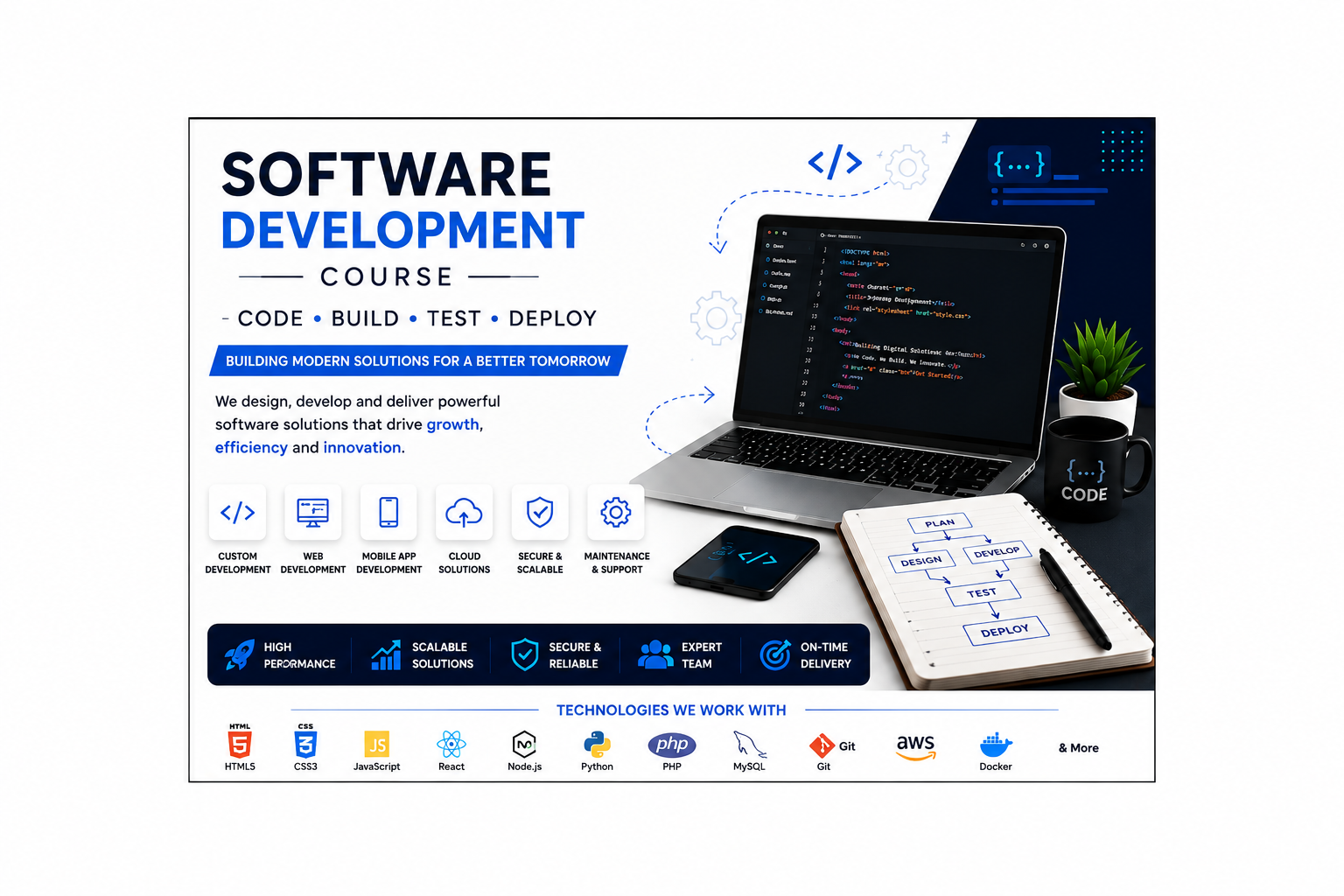
A Software Development Course is designed to help students learn how modern software applications are planned, designed, developed, tested, and maintained. Whether you are a beginner or want to improve your technical skills, a structured course can provide a clear learning path from programming fundamentals to real-world software development.
Through a software development course, students can learn how to build websites, web applications, mobile applications, and other digital solutions using modern programming languages, frameworks, and development tools.
The course focuses on both theoretical knowledge and practical learning, allowing students to understand how real software projects are developed.
A comprehensive software development course can cover the complete journey of building an application.
Students can learn:
By learning these concepts, students can develop the skills required to work on modern software projects.
A well-structured course can be divided into different learning modules.
The course begins with an introduction to software development and the role of software in today’s digital world.
Students learn:
This module helps beginners build a strong foundation before moving toward programming and development.
Programming is one of the most important parts of software development. Students learn the fundamental concepts required to write and understand code.
Topics may include:
These concepts help students develop logical thinking and problem-solving skills.
Front-end development focuses on creating the visual and interactive parts of websites and web applications.
Students can learn technologies such as:
After completing this module, students can understand how to create responsive and user-friendly interfaces.

The back-end is responsible for application logic, data processing, authentication, and communication with databases.
A software development course may introduce students to:
Learning back-end development allows students to understand how complete applications work behind the scenes.
Modern applications need databases to store and manage information.
Students can learn:
Understanding databases is important for building dynamic applications such as e-commerce websites, management systems, and mobile apps.
Writing code is not the final step in software development. Applications must also be tested to identify bugs and improve quality.
Students can learn:
This module helps students understand how developers and QA professionals work together to deliver reliable software.
A professional software development course should not only teach programming. Students should also understand how a complete software project moves from an idea to a finished application.
The typical process includes:
The first step is to understand what the client, business, or users need.
Developers and project teams identify the required features, technologies, timeline, and resources.
The structure, user interface, database, and system architecture are planned before development begins.
Developers create the front-end and back-end functionality of the application.
The software is tested to identify errors, bugs, and usability problems.
The completed application is deployed to a server, cloud platform, app store, or other production environment.
Software continues to be improved through updates, bug fixes, and new features.
Learning this complete process gives students a better understanding of how real-world software companies operate.
Practical projects are an important part of learning software development. Students should apply their knowledge by building real applications.
Possible projects include:
Working on projects helps students improve their coding skills and build a portfolio.
Modern software developers use different tools throughout the development process.
A software development course may introduce students to:
Learning these tools helps students become familiar with professional development workflows.
A structured Software Development Course provides a clear learning path instead of learning random programming topics without direction.

Students can gradually progress from basic programming concepts to building complete applications.
Explore HashLearning For Better Experience
A software development course can be suitable for different types of learners.
University and college students can improve their practical programming and development skills.
People with little or no programming experience can start with basic concepts and gradually move toward advanced development.
Individuals who want to move into the technology industry can learn the skills required for entry-level development roles.
Freelancers can learn web and application development skills to offer services to clients.
Business owners and entrepreneurs can gain a better understanding of how software products and digital solutions are developed.
After completing a software development course, students can develop valuable technical and professional skills.
These may include:
These skills can help students prepare for practical projects, internships, freelance work, and entry-level technology roles.
After learning the fundamentals, students can choose different career paths depending on their interests.
Focuses on building the user interface of websites and applications.
Works on servers, databases, APIs, and application logic.
Works with both front-end and back-end technologies.
Develops applications for Android and iOS devices.
Designs and develops complex software systems and applications.
Tests software applications, identifies bugs, and helps improve software quality.
Focuses on software deployment, automation, infrastructure, and development workflows.

One of the best ways to demonstrate your skills is by creating a software development portfolio.
During the course, students can include their projects and showcase:
A strong portfolio can help students demonstrate their practical abilities when applying for internships, jobs, or freelance projects.
Beginners often think that software development is difficult because there are many programming languages and technologies available. However, learning becomes easier when following a structured path.
A beginner can start with:
The most important thing is to practice regularly and build projects while learning.
Completing a course and building practical skills can prepare students for opportunities such as:
Career opportunities depend on the technologies learned, practical experience, portfolio, and continuous skill development.
Yes. A structured software development course can start with programming fundamentals and gradually introduce more advanced concepts.
Not necessarily. Beginners can start by learning basic programming concepts and gradually develop their skills through practice.
This depends on the course curriculum. Common technologies include HTML, CSS, JavaScript, Python, Java, PHP, and other modern programming languages.
A good software development course should include practical projects that allow students to apply what they learn.
Completing a course can provide the necessary foundation, but becoming job-ready also requires continuous practice, project development, problem-solving, and portfolio building.
Software development offers opportunities across web development, mobile applications, cloud computing, software engineering, QA, and other technology fields.
A Software Development Course can provide the knowledge and practical skills needed to understand how modern software applications are built. From programming fundamentals and web development to databases, testing, deployment, and real-world projects, students can learn the complete software development process.
Whether your goal is to become a software developer, web developer, front-end developer, full-stack developer, mobile app developer, or QA professional, learning software development can open the door to multiple career opportunities.

You must be logged in to post a comment.
