

contact info
- 3rd Floor, Gujranwala Business Center, Near KFC, G.T. Road, Gujranwala, Pakistan
- +92 303 0813333
- +92 303 0644484
- info@hashlearning.com
- info@hashlearning.com
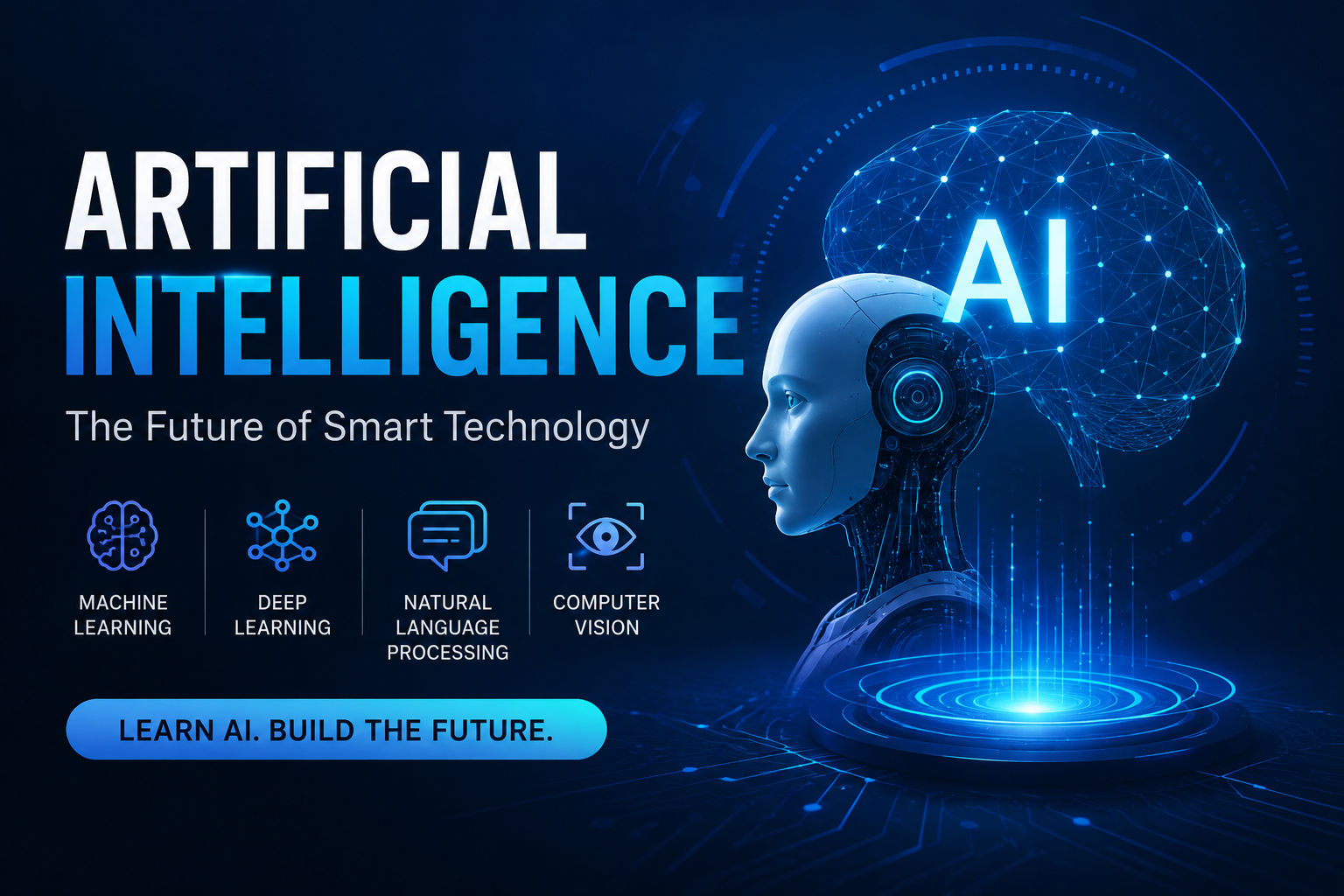
Artificial Intelligence (AI) is one of the fastest-growing technologies in the world. From smart chatbots and virtual assistants to healthcare systems, self-driving technology, and automated business solutions, AI is changing the way people work and solve problems.
An Artificial Intelligence Course helps students, professionals, and technology enthusiasts understand how AI works and how it can be used to create intelligent solutions. By learning concepts such as Machine Learning, Deep Learning, Natural Language Processing, and Computer Vision, learners can develop valuable skills for the growing technology industry.
Artificial Intelligence is a branch of computer science that focuses on creating machines and software capable of performing tasks that normally require human intelligence.
These tasks include:
Unlike traditional software that follows only predefined instructions, AI systems can analyze information, identify patterns, and make predictions based on data.
An Artificial Intelligence Course is designed to teach learners the fundamental concepts, technologies, and practical applications of AI.
Depending on the course level, students may learn how to work with data, build Machine Learning models, understand neural networks, process natural language, and develop AI-powered applications.
A well-structured AI course can provide both theoretical knowledge and practical skills that can be applied to real-world projects.
An Artificial Intelligence Course can cover several important areas of AI technology.
Machine Learning allows computers to learn from data and make predictions or decisions without being explicitly programmed for every task.
Students can learn about:
Deep Learning uses artificial neural networks to process large amounts of data and solve complex problems.
It is widely used in:
Natural Language Processing (NLP) enables computers to understand and process human language.
NLP is used in:
Computer Vision enables machines to understand and analyze images and videos.
Common applications include:
Neural networks are an important part of modern AI and Deep Learning. They are inspired by the way the human brain processes information and are used to recognize complex patterns in data.

Understanding the different types of AI is an important part of learning Artificial Intelligence.
Narrow AI is designed to perform a specific task. Most AI applications available today fall into this category.
Examples include:
General AI refers to a theoretical form of AI that could perform a wide range of intellectual tasks similar to human intelligence. It has not yet been fully achieved.
Super Artificial Intelligence is a theoretical concept in which machines could surpass human intelligence in various areas. It remains a subject of research and discussion.
Learning AI can provide valuable technical and career benefits.
AI is becoming an important part of modern technology. Learning AI can help students develop skills relevant to emerging technologies.
AI teaches learners how to analyze data, identify patterns, and develop solutions to complex problems.
An AI course can help learners apply theoretical concepts by developing projects such as chatbots, prediction systems, recommendation engines, and image recognition applications.
AI skills can open opportunities in areas such as Machine Learning, Data Science, AI development, automation, and software development.
Learning AI helps students understand how many modern applications and intelligent systems work.
Artificial Intelligence is used across many industries.
AI can assist healthcare professionals with medical image analysis, disease detection, patient monitoring, and treatment planning.
AI can support personalized learning, smart tutoring systems, automated assessments, and educational applications.
Businesses use AI for:
Financial institutions use AI for fraud detection, risk analysis, credit assessment, customer service, and financial forecasting.
Manufacturing companies use AI for predictive maintenance, quality control, robotics, and production optimization.
Online businesses use AI to provide personalized recommendations, smart search, customer behavior analysis, inventory forecasting, and automated customer support.
An AI course can be useful for a wide range of learners, including:
Basic knowledge of computers and programming can be helpful for technical AI courses, while beginner-level courses can provide the necessary foundation from the start.
Artificial Intelligence is creating new opportunities across the technology industry.
After developing AI-related skills, learners can explore roles such as:
The exact career path depends on the learner’s skills, education, experience, and specialization.
During an Artificial Intelligence Course, learners may encounter several important technologies, including:
Understanding these technologies can help learners build a strong foundation in Artificial Intelligence.
The future of AI is expected to bring significant changes to technology and business. Organizations are increasingly exploring AI to automate processes, analyze data, improve customer experiences, and develop innovative products.
Some important AI trends include:
As AI continues to evolve, learning Artificial Intelligence can help individuals prepare for emerging opportunities in the digital economy.
Although AI provides many benefits, it also comes with important challenges.
These include:
Learning responsible and ethical AI development is therefore an important part of becoming an AI professional.
An Artificial Intelligence Course can help learners move from simply understanding AI concepts to developing practical knowledge and skills.
Through structured learning and practical projects, students can understand how AI technologies work and how they are applied in real-world situations.
Whether you want to improve your technical skills, explore a career in AI, or understand emerging technologies, an AI course can provide a strong starting point.
Artificial Intelligence is no longer just a futuristic concept. It is already being used in businesses, healthcare, education, finance, e-commerce, transportation, and many other industries.
Learning AI today can help students and professionals understand one of the most important technologies shaping the future.
With the right training, learners can develop AI knowledge, work on practical projects, and prepare themselves for opportunities in the rapidly growing technology sector.
Artificial Intelligence is transforming the modern world by enabling machines and software to perform intelligent tasks, analyze data, automate processes, and support decision-making.
An Artificial Intelligence Course provides an opportunity to learn important concepts such as Machine Learning, Deep Learning, NLP, Computer Vision, and AI automation.
Whether you are a student, graduate, developer, or technology enthusiast, learning Artificial Intelligence can help you develop valuable future-ready skills and explore new career opportunities.

You must be logged in to post a comment.
